

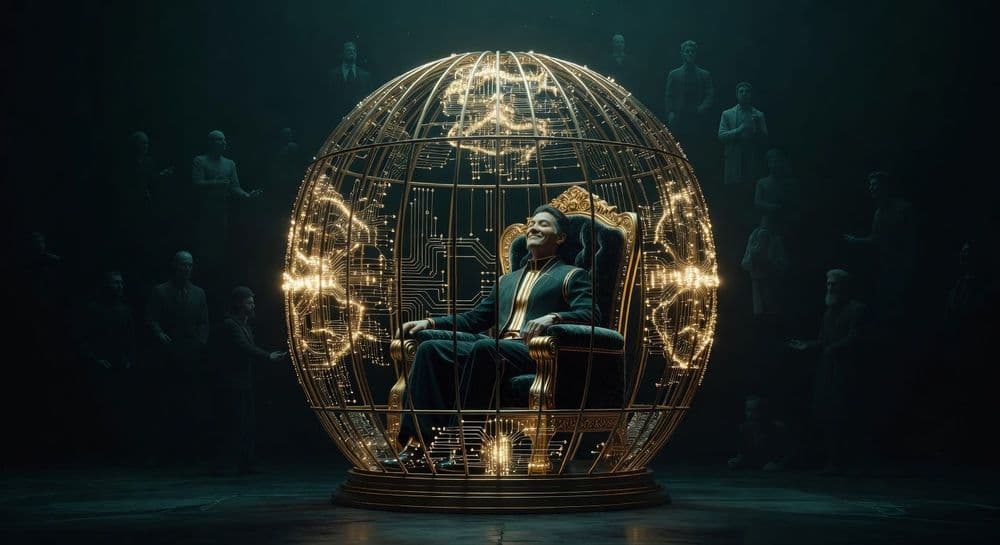
Everyone is still waiting for Skynet, a machine uprising, or sudden mass unemployment. The media diligently fuels this narrative: “the model is too dangerous,” “existential risk,” “urgent regulation is needed.”
But the real transformation is much quieter and far more radical.
Widespread deep education and independent thinking among large numbers of people is not the norm in human history. It is a brief anomaly of the last 150–200 years.
And right now, we are closing this anomaly with our own hands.
We don’t even need newer, smarter models. The current ones are more than enough — combined with our own behavior.
While tokens are artificially cheap, businesses are happily replacing people with AI. Junior developers, auditors analysts, and lawyers — entire layers of intellectual work are already cheaper and faster when done by models. From a unit-economics standpoint, it looks like a gift. If you’re a CEO and don’t incorporate AI into your cost-reduction strategy, shareholders will quickly find someone who will.
The irony is that businesses are currently being bribed with lower costs so that in 10–15 years they can take it all back with interest — and gain control.
The more we delegate not just routine tasks but thinking and responsibility to AI, the less incentive there is to raise people who can think deeply, hold large context, and truly take ownership of outcomes. Why bother if the model does 80% of the work almost for free?
We are quietly raising a generation that:
- excels at working with AI,
- thinks poorly on its own,
- is barely trained to take real responsibility.
In 10–15 years, we may arrive at a world where most people are truly competent at only one thing — formulating prompts for systems that think for them. The specialists we need today simply won’t exist in the labor market. Education will have fully adapted to this new reality by then.
And that’s when the model providers and services that survived the price war will sharply raise their prices. Turning back will then be practically impossible.
This is not a Hollywood Skynet catastrophe.
It’s a quiet and extremely convenient return to the old normal: deeply thinking, holding large context, and truly taking responsibility for the outcome is once again becoming a choice, not a mandatory program.
I myself am building part of this infrastructure at RiserLabs. Not because I want power or control, but because I genuinely love being inside this process — when a new layer of reality is born from the chaos of data and prompts.
And the further I go, the more often I catch myself asking one question:
Are we really losing control over technology?
Or have we simply created a tool that finally allows the majority to do what it has always preferred — to think less and take on less responsibility, if it’s possible to avoid it?
The question is no longer about technology.
The question is what choice each of us will make.